
Synthetic pentadecapeptide
BPC-157
Body protection compound 157
Not FDA-approvedAn experimental 15-amino-acid peptide studied largely in laboratory and animal models. It has no FDA-approved human indication or standardized clinical product.
FULL RESEARCH GRAPHIC
BPC-157 research overview
A dedicated overview of BPC-157, its preclinical evidence base, and the current 20 mg vial.
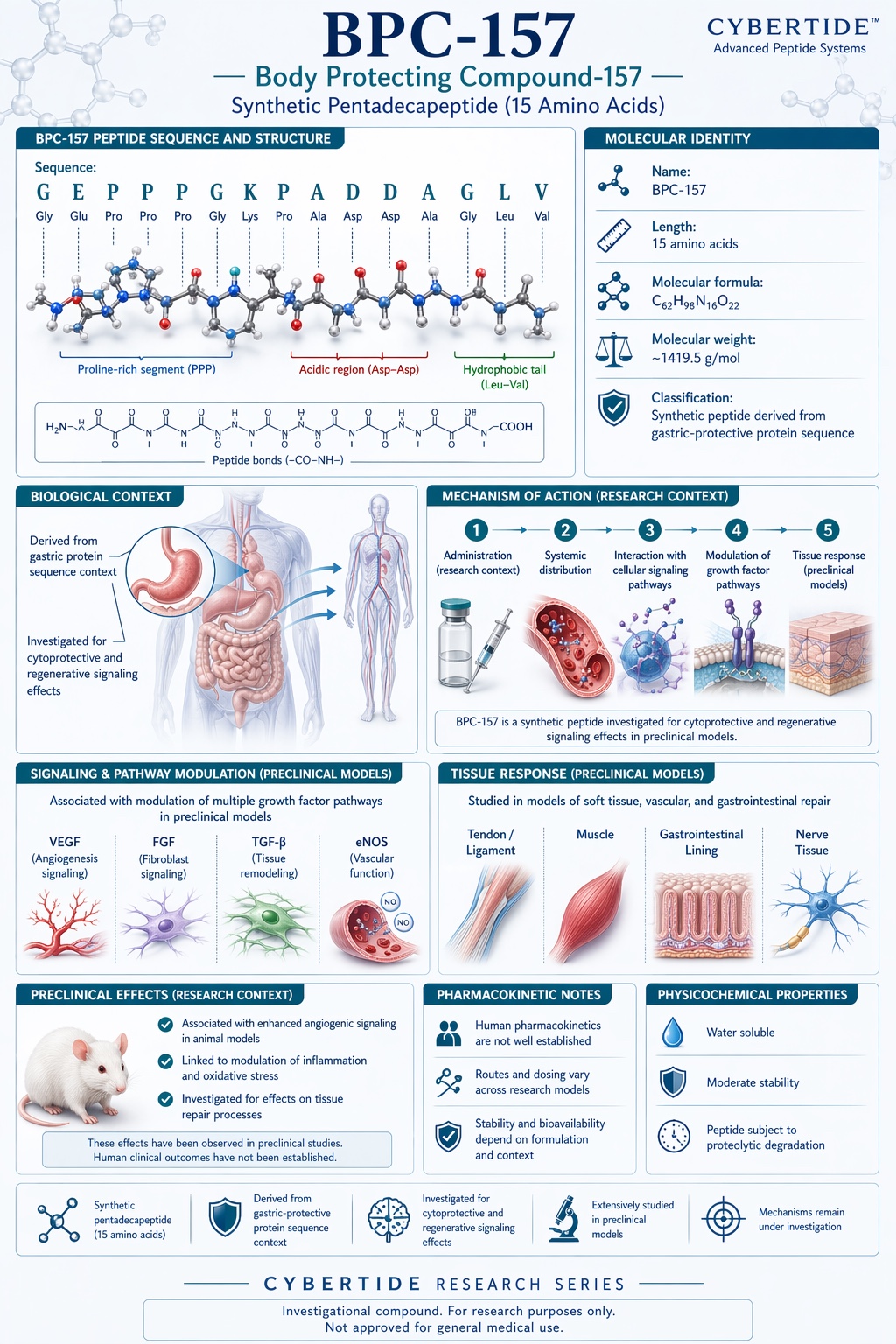
Tap the graphic to open the full-resolution version.
RESEARCH SIGNAL MAP
04 ACTIVE FIELDSEVIDENCE READOUT
Not FDA-approvedFrequently repeated healing claims are driven mainly by preclinical findings. Controlled human evidence is insufficient to establish efficacy, dosing, or long-term safety.
BOUNDARY CHECK
CONTEXT REQUIREDFDA identifies BPC-157 as a substance that may present significant safety risks in compounding, including potential immunogenicity and impurity concerns.
SUBMITTED LAB DOCUMENTS
Test results
Reports may describe other strengths or blends. Match the labeled amount, composition, and exact lot to your vial. A report for another strength does not verify your vial. Each record identifies whether an exact lot was supplied.
VIAL REFERENCE
3 mL mixing math & dosing context
Every number is labeled by evidence level. The 3 mL reference calculates concentration and U-100 volume; it does not prove solvent compatibility, sterility, stability, or suitability for injection.
20 mg vial
Change the liquid. See the amount.
Calculation only: vial amount ÷ liquid volume × draw volume. It does not determine what dose to use or confirm product compatibility.
3.0 mL BAC-water workflow
- First confirm that bacteriostatic water and a 3.0 mL final volume are compatible with the exact product and vial capacity.
- Clean both vial stoppers with alcohol and allow them to dry.
- Add the 3.0 mL slowly down the inside wall instead of directing pressure onto the powder.
- Gently roll or swirl until dissolved; do not shake.
- Use product-specific refrigeration and discard guidance. If none exists, do not invent a beyond-use date.
No established human dose
Controlled human evidence is insufficient to establish efficacy, dosing, route, cycle length, or long-term safety. Frequently repeated fixed-microgram protocols are not validated clinical guidelines.
FDA — compounding safety risks ↗U-100 means 100 units = 1.0 mL. Any table result above 100 units exceeds one standard 1 mL U-100 syringe.